
Psoriasis of the nails

Nail psoriasis is when psoriasis shows up on the fingernails and toenails. The ongoing inflammation can change the shape and color of the nails. In this article, you'll learn how psoriasis shows up on the nails and how it is treated.
How common nail psoriasis is
Nail psoriasis is not at all rare and occurs in up to 80% of people with psoriasis. If people also have psoriatic arthritis in addition to their skin symptoms, the likelihood of nail psoriasis may be even higher. Psoriatic arthritis is a joint disease that is treated by a rheumatologist (you can learn more about psoriatic arthritis here).
The causes of nail psoriasis are not yet fully understood, but as with psoriasis of the skin, a combination of inherited predisposition and external triggers such as infections, medications or stress is involved in how it develops.
Typical nail changes
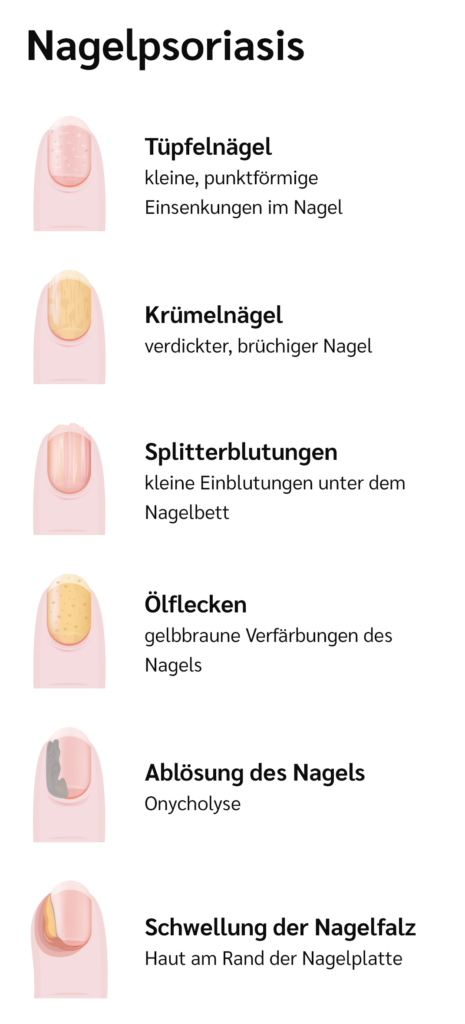
Nail psoriasis can affect both fingernails and toenails. There are a number of typical signs that are characteristic of nail psoriasis. These include:
- Nail pitting (small, dot-like dents in the nail)
- Crumbling nails (thickened, brittle nail)
- Splinter hemorrhages (small, line-shaped bleeding under the nail plate)
- Oil drop spots (yellowish-brown discoloration of the nail)
- Separation of the nail (onycholysis)
- Swelling of the nail fold (skin at the edge of the nail plate)
Your doctor usually makes the diagnosis based on how the nails look. Plaque psoriasis of the skin is often present as well. Because the nail changes can also occur with nail fungus or malnutrition, an ultrasound or a tissue examination of the nail can provide further clarity if there is any doubt.
How psoriasis of the nails is treated
Treating nail psoriasis in good time is important to prevent damage to the nails and to keep the inflammation in check. Your doctor decides which treatment is right depending on how severe and widespread it is. The most important medications are:
- Urea
- Cortisone
- Vitamin D3 products
Mild nail psoriasis is usually treated with topical medications, meaning ones applied to the skin. The active ingredients used are urea, cortisone or vitamin D3 products. They are applied to the affected areas as ointments, solutions or foams. Light therapy may also be an option.
If the nail bed is affected, it may be necessary to remove the nail first and then start treatment. Internal treatment (systemic therapy) may be needed in more severe cases. So-called biologics work especially well in these situations. They target the disease processes specifically and usually work well and are well tolerated.
Treatment can take some time
The choice of the right treatment for nail psoriasis is always tailored to the individual case. The number of affected nails, where the nail symptoms are located (nail bed, surrounding skin) and whether skin psoriasis is also present and how severe it is all influence the decision on the right treatment.
Important: It often takes some time before you see results when treating nail psoriasis. That's why regular treatment and some patience are important. Even after the symptoms have healed, the nail changes may remain visible for quite a while until the nail has grown out.
Impact on quality of life
Because nail psoriasis appears in a very visible place, it is unfortunately hard to hide in everyday life. We need our hands on many occasions, including when we're in contact with other people, for example when shaking hands or gesturing. That's why, in addition to the physical symptoms, people with nail psoriasis often also find their quality of life severely affected.
Important: If you are struggling a lot, it's important to bring this up with your doctor. The psychological effects can be enormous and should be taken into account in your treatment.
Sources:
- Kassir M, Kircik L, Weinberg J, Fatima F, Yamauchi P, Lotti T, Wollina U, Grabbe S, Goldust M. Treatment of Nail Psoriasis. J Drugs Dermatol. 2022 Feb 1;21(2):146-150. doi: 10.36849/jdd.4969. PMID: 35133106.
- Bardazzi F, Starace M, Bruni F, Magnano M, Piraccini BM, Alessandrini A. Nail Psoriasis: An Updated Review and Expert Opinion on Available Treatments, Including Biologics. Acta Derm Venereol. 2019 May 1;99(6):516-523. doi: 10.2340/00015555-3098. PMID: 30521057.
- Thomas L, Azad J, Takwale A. Management of nail psoriasis. Clin Exp Dermatol. 2021 Jan;46(1):3-8. doi: 10.1111/ced.14314. Epub 2020 Aug 2. PMID: 32741010.
- Rigopoulos D, Rompoti N, Gregoriou S. Management of Nail Psoriasis. Dermatol Clin. 2021 Apr;39(2):211-220. doi: 10.1016/j.det.2020.12.014. Epub 2021 Feb 11. PMID: 33745634.
- Manhart R, Rich P. Nail psoriasis. Clin Exp Rheumatol. 2015 Sep-Oct;33(5 Suppl 93):S7-13. Epub 2015 Oct 15. PMID: 26472140.
- https://www.aad.org/public/diseases/psoriasis/treatment/genitals/nails (external), accessed March 3, 2022
- https://www.psoriasis.org/hands-feet-nails/ (external), accessed March 7, 2022
- https://www.psoriasis.info/formen/nagelpsoriasis (external) (in German), accessed March 3, 2022