
Psoriatic arthritis

Psoriasis is a condition that does not only affect the skin. About one in three patients also has psoriatic arthritis, a painful inflammation of the joints. It is one of the inflammatory rheumatic diseases and is treated by a rheumatologist.
The joint inflammation usually appears at the same time as psoriasis of the skin or some time after it. In rare cases, the joints can also become inflamed without any skin symptoms.
The exact causes are not known, but there are some risk factors that make psoriatic arthritis more likely. These include particularly extensive skin involvement, a family history and psoriasis of the nails.
Different forms
The joint inflammation most often occurs in the small joints of the fingers and toes, and often all the joints of one finger or toe are affected. But large joints such as the knee or the spine can also become inflamed.
Psoriatic arthritis can show itself in different ways. The first symptoms can be similar to those of rheumatoid arthritis. Symptoms can include the following:
pain and swelling
stiffness and limited mobility, especially in the morning
general exhaustion (fatigue)
dactylitis, meaning all the joints of one finger or toe are affected
inflammation where tendons attach to bone (enthesitis)
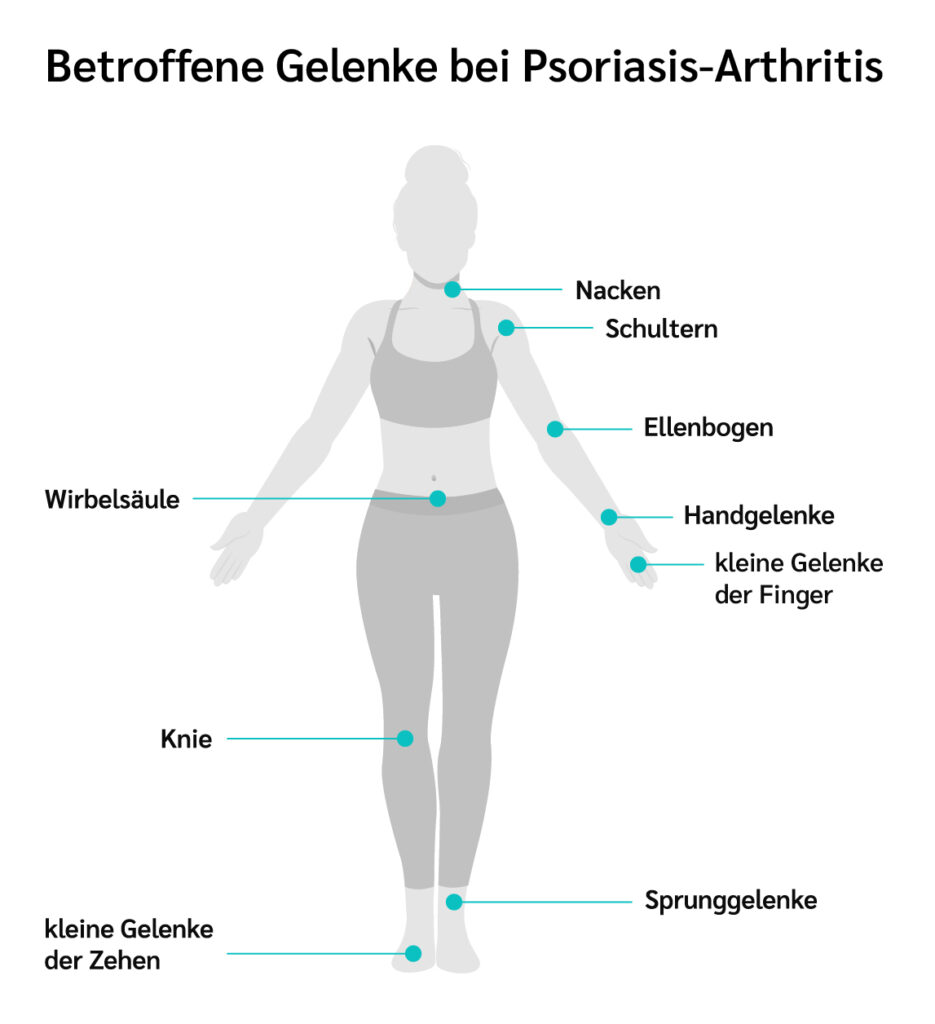
Early treatment to prevent lasting joint damage
A timely diagnosis is important so that treatment can be started and the progression of the disease slowed down. The doctor makes the diagnosis based on the symptoms and a physical examination. Imaging such as ultrasound or X-rays can give additional information about how the disease is progressing or how well the treatment is working.
In cases of severe inflammation and pronounced symptoms, products containing cortisone can be used for a short time. They are usually injected directly into the affected joint and work quickly.
To stop the disease from progressing, so-called conventional disease-modifying drugs (csDMARDs) such as methotrexate or ciclosporin A are used, which are also used to treat psoriasis of the skin. They usually start to work after a few weeks to months. They reduce the inflammation in the joints and in this way reduce both the symptoms and further damage to the joints.
If conventional disease-modifying drugs are not tolerated or don't work well enough, medications from the group of biologics are used. Biologics are proteins produced using biotechnology. They are similar to substances made by the body and act on the immune system in a targeted way by blocking messengers in the body that trigger the inflammation.
Adding non-drug measures to treatment

Medications are the foundation of treatment for psoriatic arthritis. In addition, patients can also help keep the disease under control with non-drug measures.
Physical therapy can help reduce pain and prevent long-term damage to the joints. Joint-friendly sports such as cycling, walking or swimming are also good for maintaining mobility and relieving symptoms. Besides regular exercise, lifestyle changes such as a healthy diet, losing weight if needed and quitting smoking can also have a positive effect on the course of the disease.
Sources:
- Menter A. Psoriasis and psoriatic arthritis overview. Am J Manag Care. 2016 Jun;22(8 Suppl):s216-24. PMID: 27356193.
- Azevedo VF, Buiar PG. Risk factors and predictors of psoriatic arthritis in patients with psoriasis. An Bras Dermatol. 2013 Mar-Apr;88(2):233-6. doi: 10.1590/S0365-05962013000200008. PMID: 23739697; PMCID: PMC3750886.
- Menter A. Psoriasis and psoriatic arthritis treatment. Am J Manag Care. 2016 Jun;22(8 Suppl):s225-37. PMID: 27356194.