
Cream, ointment, lotion: what's the difference?
With psoriasis, regular skin care is an important part of treatment. Choosing the right products isn't always easy, especially if you have sensitive skin. Your dermatologist may also prescribe an ointment one time and a cream another time, and it's easy to lose track of which product is good for what.
Ointments, creams, gels and lotions differ mainly in how much fat and water they contain. The name of a product depends on its base (also called the vehicle), which carries the active ingredient and determines its different properties. The so-called "ointment triangle" offers a good overview.
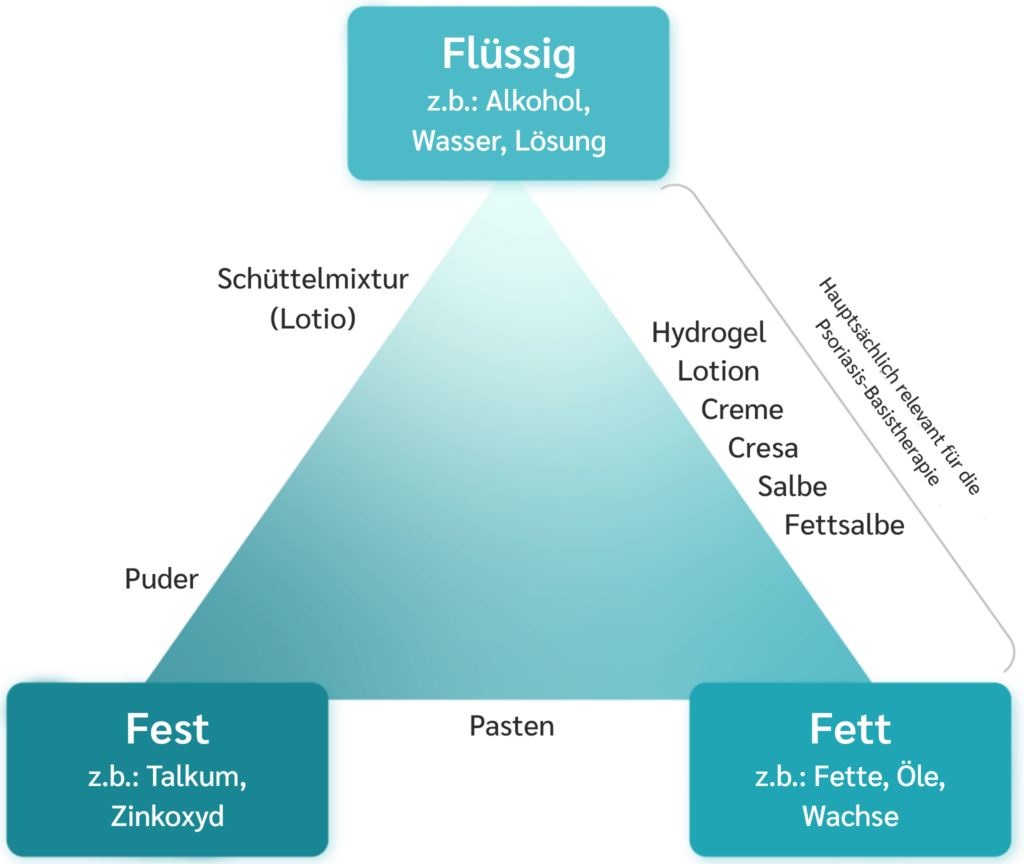
Creams, lotions, gels and ointments
Emulsions: An emulsion is a mixture of two liquids that don't normally mix with each other, such as oil and water. An emulsifier is needed so that one liquid stays spread out as fine droplets in the other. Creams and lotions are emulsions.
Creams: Creams consist of fat (oil) and water in varying proportions.
- If the cream contains more water than oil, droplets of fat sit in a watery phase, and the cream is called an oil-in-water emulsion (O/W cream). Oil-in-water emulsions absorb quickly, have a cooling effect and provide moisture. Water-rich, cooling creams are often prescribed for inflamed areas of skin.
- In a water-in-oil emulsion (W/O cream), the fat content is higher than the water content, and the water is spread out as tiny droplets in the oil. A water-in-oil emulsion absorbs a little more slowly but protects better against drying out.
Lotions: Lotions are basically thinner creams with a high water content. They are especially suitable for large areas of skin or hairy areas because they spread easily and absorb quickly. They also have a cooling effect.
Gels: Gels are usually water-rich preparations that are not emulsions: a gelling agent gives them a jelly-like consistency. When applied, the water they contain evaporates, so gels have a cooling effect. They contain little or no fat and are therefore also suitable for hairy areas such as the scalp.
Ointments: Ointments contain no water or only a little. If an ointment contains no water at all, it is called a water-free ointment. Ointments are rich in fat and leave a protective layer on the skin. They don't absorb as quickly and therefore stay on the skin longer. That's why they are used especially for very dry, heavily scaling skin.
Powders, pastes and shake lotions
Powders: Powders are sprinkled onto the skin and stick to it. They consist of fine solid particles, often talc or zinc oxide. Powders have a drying effect and form a protective film on the skin. They are used, for example, for fungal infections or in skin folds.
Pastes: In addition to fat, pastes contain a high proportion of powder. They are very firm and hard to spread, so they are mainly suited to covering limited areas of skin. If the fat content is high, heat and moisture can build up under the paste.
Shake lotion: A shake lotion contains liquid and solid ingredients that settle and are shaken up before applying. A common solid ingredient is zinc oxide. Shake lotions cool and dry the skin and can relieve itching.
Which base is right?
The base of a product always depends on the current condition of your skin, and if that changes, the treatment is adjusted. The area of the body being treated can also play a role in choosing the right product. Another factor is the time of year. In summer, when it's warm and you sweat a lot, lighter creams and lotions with a higher water content are often better suited. Heat can build up under greasy ointments and irritate the skin.
It's also important that the base feels comfortable to you in everyday life. A study from Portugal suggests that people with psoriasis who have larger areas of skin affected use gels and creams more regularly than ointments, probably because they are easier to apply. If a product feels unpleasant to you, talk to your dermatologist about a different base. You can read more about daily care in our skin care tips.
Pay attention to shelf life
Some products for sensitive skin contain no or only a few preservatives and therefore only keep for a limited time after opening. Besides the expiration or best-before date, the package often also tells you how long the product keeps after opening. Products made individually at the pharmacy also have a limited shelf life, and you shouldn't go past the use-by period the pharmacy gives you.
Sources
- Teixeira A et al.: Does the Vehicle Matter? Real-World Evidence on Adherence to Topical Treatment in Psoriasis. Pharmaceutics, 2021. doi.org/10.3390/pharmaceutics13101539