
Why your gut flora matters for psoriasis
Did you know that trillions of bacteria, viruses and fungi live in your gut? The number of bacteria in the body alone, most of them in the large intestine, is estimated at around 38 trillion. Even if that sounds a bit unappetizing at first, these microorganisms are hugely important. Together they make up the gut flora, also called the gut microbiome. These countless helpers don't just break down food, they also play an important role in the immune system. In this article, you'll learn what is known about the link between your gut microbiome and your skin.
Your gut is shaped by many influences
The makeup of the gut microbiome depends on things like diet or taking antibiotics. For the microorganisms to handle their many tasks, they above all need a well-balanced team. Ideally, the gut flora is made up of many different bacterial strains. When the bacteria live in a balanced ratio in the digestive tract, they help fend off pathogens and keep inflammation in check.
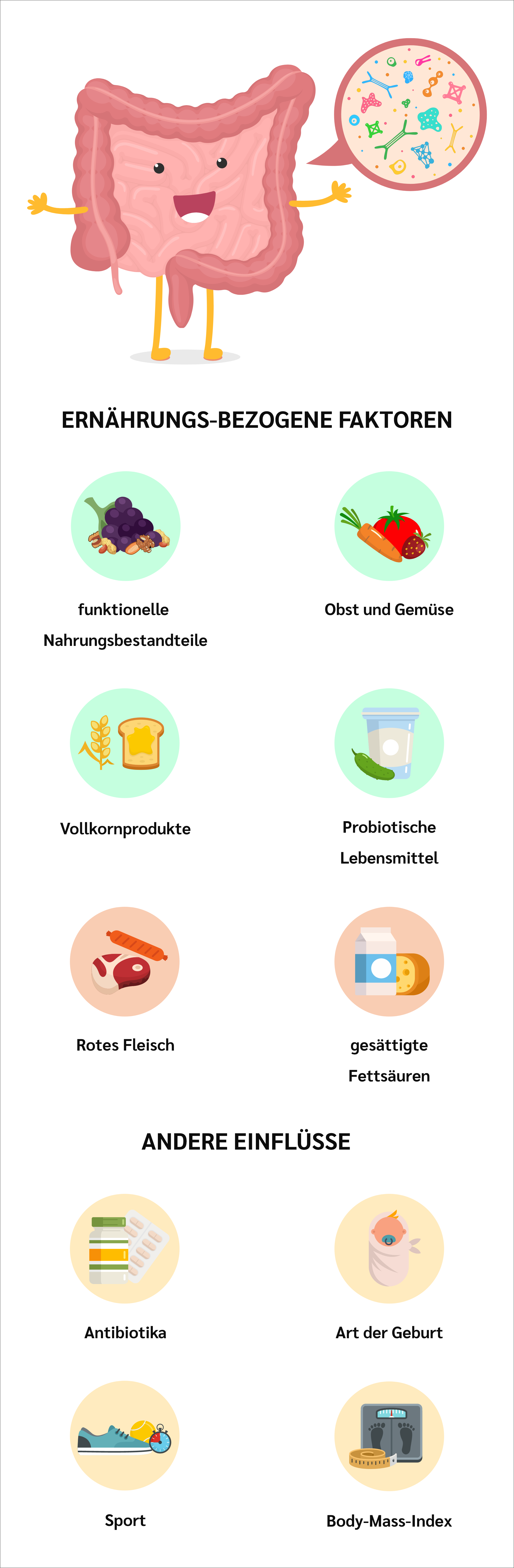
Shown in green are diet-related factors that can have a positive effect on the gut microbiome; red: rather unfavorable influences; yellow: other influences that can be partly beneficial, partly harmful. Graphic adapted from Buhaș et al., 2022.
An imbalanced gut flora can put a strain on your immune system and skin
When the microbiome is out of balance, there are not enough of the “good” bacterial strains and too many of the rather “bad” bacteria. This is called dysbiosis, an imbalance of microbes in the gut. An unhealthy diet, antibiotics and lack of exercise can contribute to an imbalanced gut flora. Dysbiosis has been linked to various health effects:
- Inflammation: chronic inflammatory reactions in the body
- Psoriasis: skin health has been linked to dysbiosis in the gut
- Digestive problems such as bloating, diarrhea or stomach cramps
- Weakened immune defenses: higher susceptibility to infections
Mental health, bowel diseases and weight gain have also been linked to the gut microbiome.
The gut microbiome is different in psoriasis
Everyone has a unique microbiome in their gut. Scientific studies show that the gut flora of people with psoriasis is made up differently than that of people without psoriasis. How much the microbiome is changed may also be related to how severe the psoriasis is. Whether the changed gut flora is a cause or a consequence of the condition is not yet clear. More research is needed to understand and put these links into context.
A vicious circle via the gut-skin axis?
Researchers assume that the skin and the gut influence each other. This connection is called the “gut-skin axis,” and the microbiome plays an important role in it. In a study in mice, certain gut bacteria (Staphylococcus aureus and Streptococcus danieliae) increased inflammation in the skin.
The researchers suspect that, the other way around, skin inflammation also favors certain gut bacteria, which in turn weaken the gut barrier, contribute to inflammation throughout the body and make the skin worse. This could create a kind of “vicious circle.” Whether this works the same way in humans still needs to be studied. In addition, dysbiosis in the gut has been linked to related conditions such as diabetes and severe overweight.
You can read how to have a positive influence on your gut flora in part two: Gut microbiome: new paths to skin health.
Sources
- Chen L, Li J, Zhu W, Kuang Y, Liu T, Zhang W, Chen X, Peng C. Skin and Gut Microbiome in Psoriasis: Gaining Insight Into the Pathophysiology of It and Finding Novel Therapeutic Strategies. Frontiers in Microbiology, 2020. doi:10.3389/fmicb.2020.589726
- Buhaș MC, Gavrilaș LI, Candrea R, Cătinean A, Mocan A, Miere D, Tătaru A. Gut Microbiota in Psoriasis. Nutrients, 2022. doi:10.3390/nu14142970
- Olejniczak-Staruch I et al. Alterations of the Skin and Gut Microbiome in Psoriasis and Psoriatic Arthritis. International Journal of Molecular Sciences, 2021. doi:10.3390/ijms22083998
- Okada K, Matsushima Y, Mizutani K, Yamanaka K. The Role of Gut Microbiome in Psoriasis: Oral Administration of Staphylococcus aureus and Streptococcus danieliae Exacerbates Skin Inflammation of Imiquimod-Induced Psoriasis-Like Dermatitis. International Journal of Molecular Sciences, 2020. doi:10.3390/ijms21093303
- Sender R, Fuchs S, Milo R. Revised Estimates for the Number of Human and Bacteria Cells in the Body. PLOS Biology, 2016. doi:10.1371/journal.pbio.1002533